
How to Read Roman Imperial Coin Legends: Abbreviations, Titles and Dates
Oct
A Roman coin can carry a remarkable amount of information in a very small space. Around the emperor’s portrait, or surrounding the design on the reverse, a few abbreviated words may proclaim his name, religious authority, political powers and military honours.
At first, an inscription such as P M TR P COS VI P P can look bewildering. Once you recognise the individual parts, however, it becomes much easier to understand:
“Chief priest, holding tribunician power, consul for the sixth time, father of the fatherland.”
These titles were more than decoration. They presented the emperor’s authority to everyone who handled his coins, and, for collectors today, they can provide valuable clues to identification and dating.
Getting started: reading the letters
The inscription on a coin is called its legend. The portrait side is the obverse, while the other side is the reverse.
Before attempting a translation, a few conventions help:
- V also represents U. AVGVSTVS is the familiar name Augustus.
- I also represnts J TRAIAN is the more familiar Trajan. The letters U and J wouldn’t be in common use for hundreds of years after the fall of Rome.
- Words are usually abbreviated. PONTIF MAXIM and P M can both represent Pontifex Maximus.
- Spaces and punctuation are inconsistent. A continuous string of letters needs to be divided into recognisable names and titles.
- The inscription can continue across both sides. An emperor’s titles may begin around his portrait and finish on the reverse.
- Numbers belong to the title immediately before them. COS VI means a sixth consulship; it does not mean the sixth year of a reign.
Wear, an off-centre strike or a small flan, the piece of metal on which the coin was struck, may leave part of the inscription missing. Start with the letters you can see clearly.
The principal abbreviations
The following are among the most useful titles to recognise on coins of the early and middle Roman Empire. Latin endings can change according to the grammar of the inscription; these are the standard forms used to explain the titles.
| Abbreviation | Latin | Meaning |
|---|---|---|
| IMP | Imperator | A title associated with victorious military command; also part of imperial titulature |
| CAES / CAESAR | Caesar | Originally a family name, subsequently an imperial title |
| AVG | Augustus | The principal title of an emperor |
| P M / PONT MAX / PONTIF MAXIM | Pontifex Maximus | Chief priest of Roman state religion |
| TR P / TR POT / TRIB POT | Tribunicia potestas | Tribunician power |
| COS | Consul | Holder of the consulship; a following numeral records the numbered consulship |
| P P | Pater patriae | Father of the fatherland |
These titles recur in different combinations, rather than following a single fixed formula. A useful illustrated introduction appears in Liane Houghtalin’s discussion of Roman coins and their inscriptions.
Why did emperors have so many titles?
Roman imperial rule grew out of the cataclysmic civil wars that ended the Republic but Augustus wanted to retain legitimacy, as the ultimate victor of those civil wars, he styled himself as the first citizen, the principate of the Republic. Augustus accumulated powers, offices and honours that gave him authority while preserving recognisable Republican forms. He was a de facto monarch avoiding calling himself a king.
His own account, the Res Gestae, records his tribunician power, appointment as Pontifex Maximus, receipt of the name Augustus and recognition as Pater Patriae. These were distinct elements of his public position, acquired at different times. Later emperors used much of the same vocabulary. Read Augustus’s account in translation.
IMP: military authority
Imperator originally belonged to the language of military command. During the Republic, troops could acclaim a successful commander as imperator. Under the emperors, it became a regular element of the ruler’s titles.
Its position matters. IMP at the beginning of a name commonly forms part of the imperial naming formula. IMP followed by a numeral records a numbered imperial acclamation.
An emperor’s military honours could reflect victories won by his generals: they do not necessarily show that he personally commanded the campaign.
CAESAR and AVG: from names to imperial titles
Caesar began as a family name associated above all with Julius Caesar. Through adoption and succession, it became part of the language of imperial legitimacy. Its use evolved, and it increasingly served to distinguish a junior ruler or intended successor.
Augustus, an honorific granted to Octavian in 27 BC, became the principal title of subsequent emperors. It conveyed dignity and reverence, rather than naming a traditional Republican office.
The distinction is useful, but context matters: on early imperial coins, CAESAR does not automatically mean “heir apparent.”
P M: Pontifex Maximus
The Pontifex Maximus headed the college of pontiffs, an important priestly body concerned with Roman public religion.
The office existed long before the Empire. Julius Caesar held it, and Augustus assumed it in 12 BC, after the death of its previous holder, Lepidus. Augustus specifically describes waiting until the office became vacant. Under his successors, it became a familiar part of imperial authority. Augustus, Res Gestae, chapter 10.
On coins, P M, PON MAX and PONTIF MAXIM can therefore convey the same title.
TR P: tribunician power
The tribunes of the plebs were Republican officials associated with protecting the interests of ordinary Roman citizens. Their powers included intervention in public business and protection of their persons.
Emperors adopted tribunician power, rather than simply serving as ordinary tribunes. It became an important expression of their civil authority.
For collectors, its particular value is the number that often follows it: TR P X = holding tribunician power for the tenth time.
This count can help date an issue, but it is not automatically the emperor’s tenth year as sole ruler. Some future emperors received tribunician power before their accession, and the dates on which the count advanced varied over time. Dating requires the chronology of the particular ruler.
COS: consul
The consulship was one of the highest offices of the Roman Republic. It continued under the Empire, retaining considerable prestige even as political power became concentrated in the emperor.
COS VI means consul for the sixth time. The numeral counts consulships, not years: an emperor did not necessarily take a new consulship annually.
A numbered consulship could remain in his titulature after his actual term in office ended. Consequently, COS VI may cover several years of coin production.
P P: Pater Patriae
Pater Patriae, “father of the fatherland,” was an honour expressing the ruler’s supposed paternal care for the Roman community.
It was an honorary distinction, rather than an office with a separate set of governing powers. Augustus received it in 2 BC, describing its bestowal by the Senate, equestrian order and Roman people. Later emperors did not necessarily accept it immediately on accession. Augustus, Res Gestae, chapter 35.
Tiberius denarius, the “tribute penny”
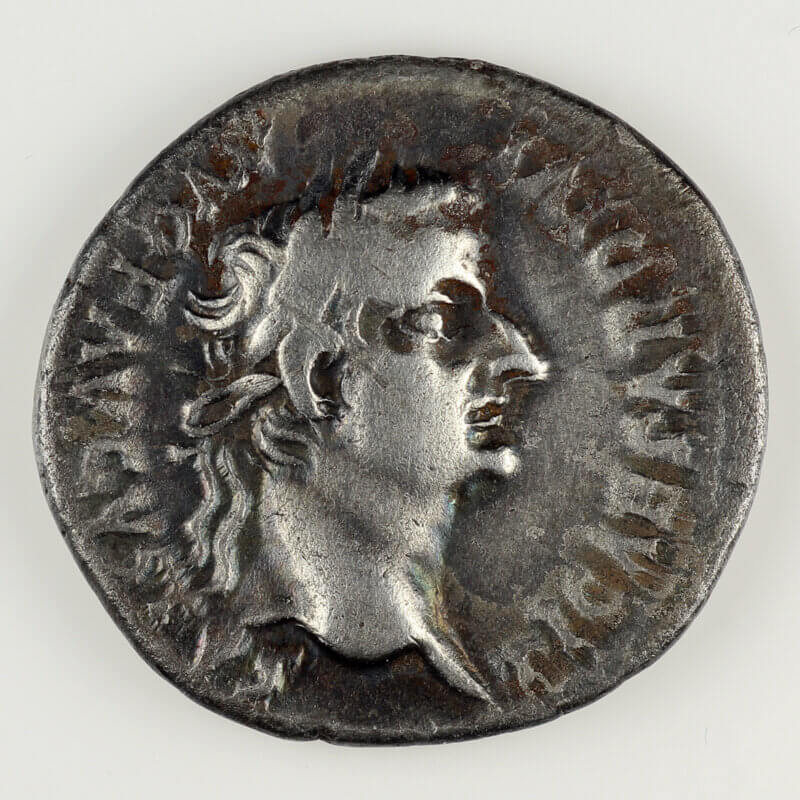
This Tiberius denarius from my stock provides an excellent starting point. Struck at Lugdunum, modern Lyon, its legends combine the emperor’s name, his relationship to his predecessor and his religious office.
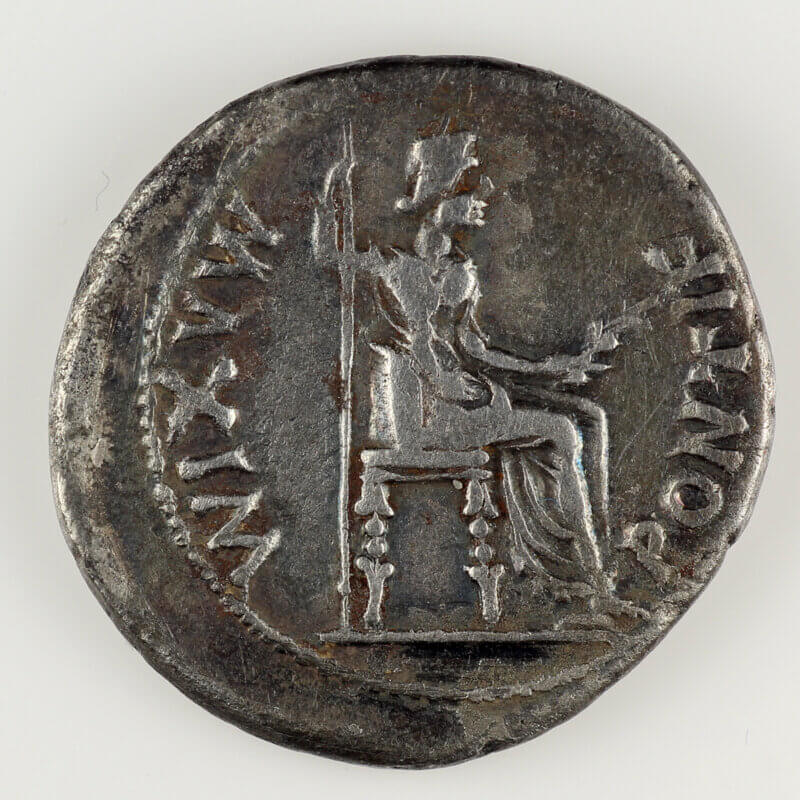
AJB Collectables A491. Tiberius denarius, RIC 30; 19mm, 3.59g. View the original listing.
Obverse: TI CAESAR DIVI AVG F AVGVSTVS
| Inscription | Meaning |
|---|---|
| TI | Tiberius |
| CAESAR | Caesar |
| DIVI AVG F | Divi Augusti filius: son of the deified Augustus |
| AVGVSTVS | Augustus, the imperial title |
Together, this reads: “Tiberius Caesar Augustus, son of the deified Augustus.”
Tiberius was Augustus’s adopted son. The legend proclaims that relationship, presenting him as the legitimate successor to a predecessor who had received divine honours.
Reverse: PONTIF MAXIM
This expands to Pontifex Maximus, meaning chief priest. Although it surrounds a seated female figure, the title belongs to Tiberius. A reverse legend does not necessarily name the figure pictured beside it.
There are no numbered consulships or tribunician powers here to identify a particular year. The listing dates the type broadly to AD 14–37, Tiberius’s reign.
Trajan and P M TR P COS VI P P
This Trajan denarius gives us the very sequence of abbreviations introduced at the beginning of the article. His names and victory titles fill the obverse, while further titles continue around Virtus on the reverse.
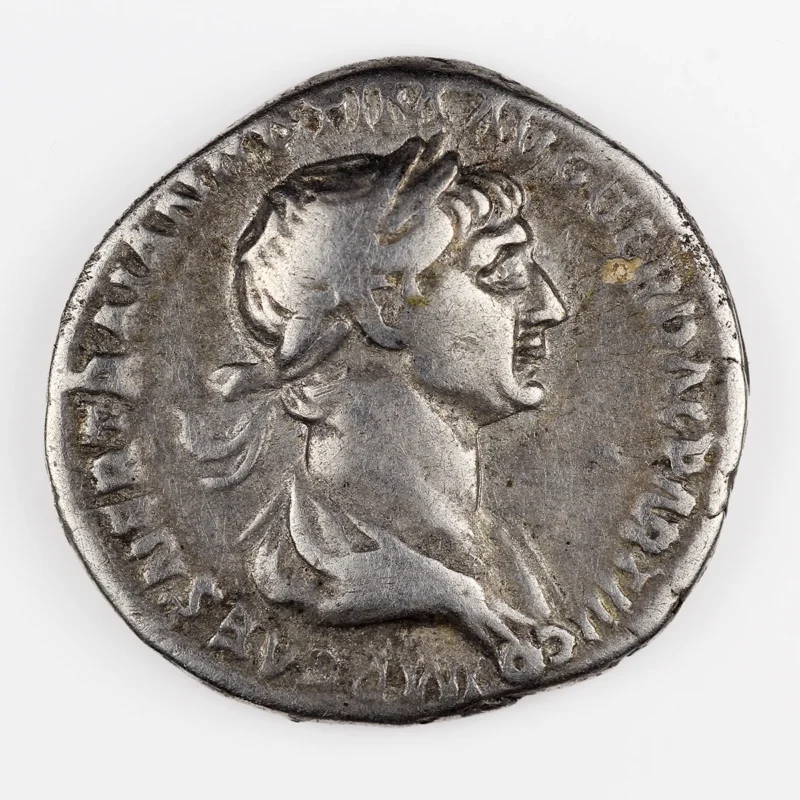
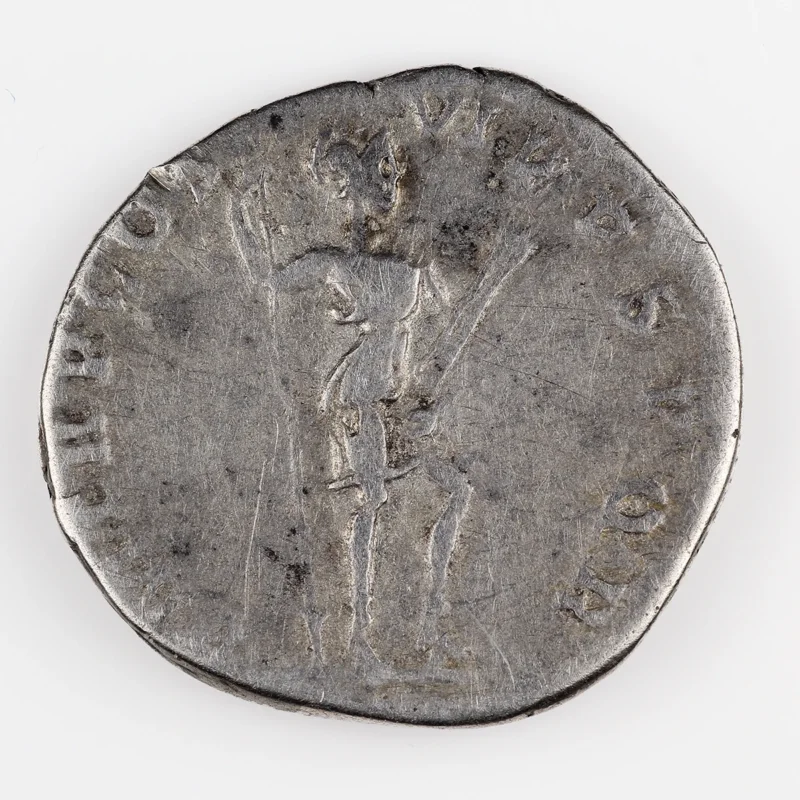
A373. Trajan denarius, catalogued as RIC 353; 19mm, 3.21g. View the coin listing.
Obverse: IMP CAES NER TRAIAN OPTIM AVG GER DAC PARTHICO
| Inscription | Meaning |
|---|---|
| IMP | Imperator |
| CAES | Caesar |
| NER | Nerva, reflecting Trajan’s adoption by that emperor |
| TRAIAN | Trajan |
| OPTIM | Optimus, “best” |
| AVG | Augustus |
| GER | Germanicus, a victory title referring to the Germans |
| DAC | Dacicus, a victory title referring to the Dacian campaigns |
| PARTHICO | A form of Parthicus, a victory title referring to the Parthians |
Reverse: P M TR P COS VI P P S P Q R
| Inscription | Meaning |
|---|---|
| P M | Pontifex Maximus: chief priest |
| TR P | Holding tribunician power |
| COS VI | Consul for the sixth time |
| P P | Pater Patriae: father of the fatherland |
| S P Q R | Senatus Populusque Romanus: the Senate and People of Rome |
The emperor’s titles on the reverse therefore read: “Chief priest, holding tribunician power, consul for the sixth time, father of the fatherland.”
The final S P Q R names the Senate and People of Rome. It is not another personal title.
Notice that VI belongs to COS. It records Trajan’s sixth consulship, rather than his sixth year as emperor. There is no numeral after TR P on this coin, so that title does not supply an annual count.
Antoninus Pius and numbered tribunician power
This Antoninus Pius denarius from sold stock adds something missing from the Trajan example: a number immediately following TR P.
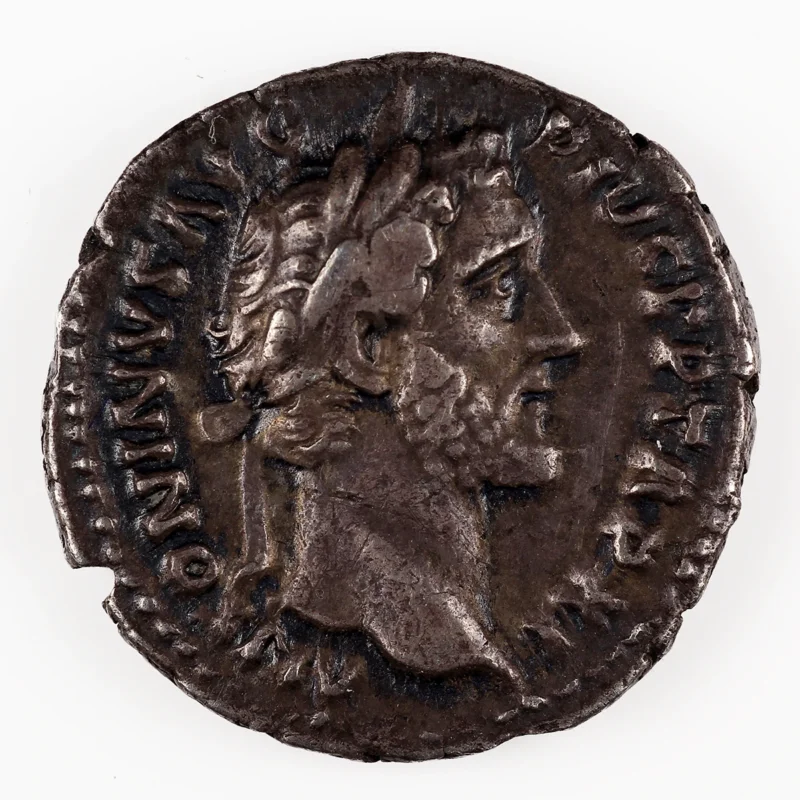
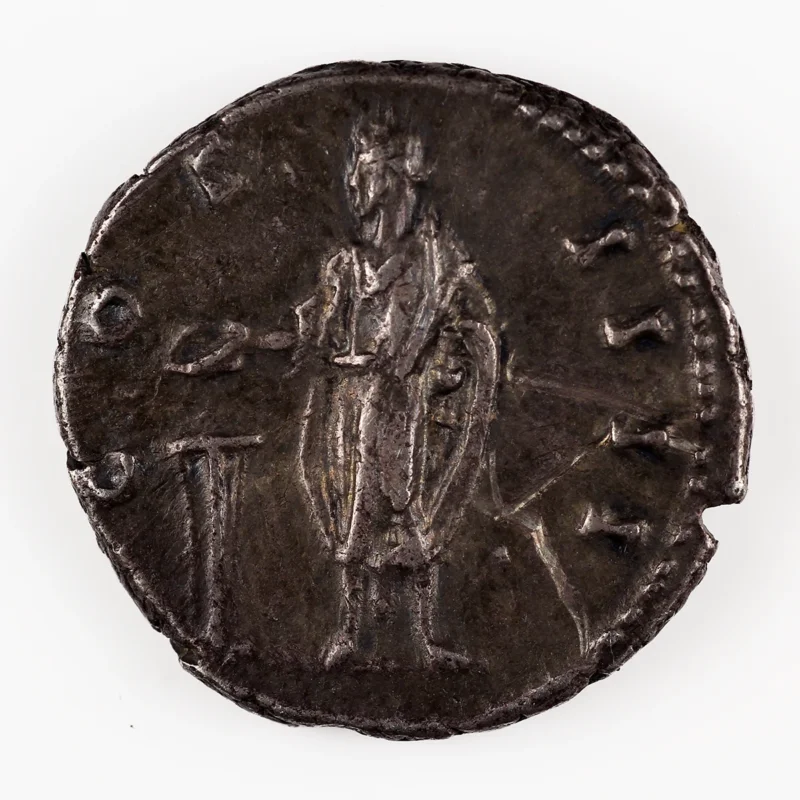
A364. Antoninus Pius denarius, RIC 220; 18mm, 2.86g. View the original listing.
Obverse: ANTONINVS AVG PIVS P P TR P XVI
| Inscription | Meaning |
|---|---|
| ANTONINVS | Antoninus |
| AVG | Augustus |
| PIVS | Pius, an honorific conveying dutifulness and religious devotion |
| P P | Father of the fatherland |
| TR P XVI | Holding tribunician power for the sixteenth time |
Reverse: COS IIII
This means “consul for the fourth time.” The coin uses IIII for four, rather than the IV familiar from many modern presentations of Roman numerals.
Here, two separate counts appear on the same coin:
- TR P XVI: the sixteenth tribunician period.
- COS IIII: the fourth consulship.
They count different things and should not be added together or treated as competing statements of the emperor’s regnal year.
The listing dates this issue to AD 152–153. This is the practical value of numbered tribunician powers: once matched to the particular emperor’s chronology, they can narrow a coin’s date considerably.
A practical method for reading your own coin
- Transcribe the visible letters. Leave gaps where the inscription is worn or missing.
- Find the ruler’s name. Look for recognisable groups such as TRAIAN, HADRIAN or ANTONINVS.
- Separate names from titles. Mark familiar abbreviations such as AVG, P M, TR P and COS.
- Attach each numeral to the correct title. Keep TR P numbers distinct from COS and IMP numbers.
- Read both sides. Titles and dating clues may be distributed across the coin.
- Compare the complete type with a reference. Match the portrait, inscription and reverse design together.
A useful starting point is Online Coins of the Roman Empire, which brings together descriptions and collection examples arranged around The Roman Imperial Coinage catalogue.
A miniature statement of imperial authority
Roman imperial legends become much less intimidating once you recognise their recurring parts. The letters around a portrait describe how an emperor wished to be understood: a legitimate successor, victorious commander, religious leader and guardian of the Roman state.
Begin with IMP, CAES, AVG, P M, TR P, COS and P P, and a seemingly impenetrable ring of lettering starts to become a readable historical document.